
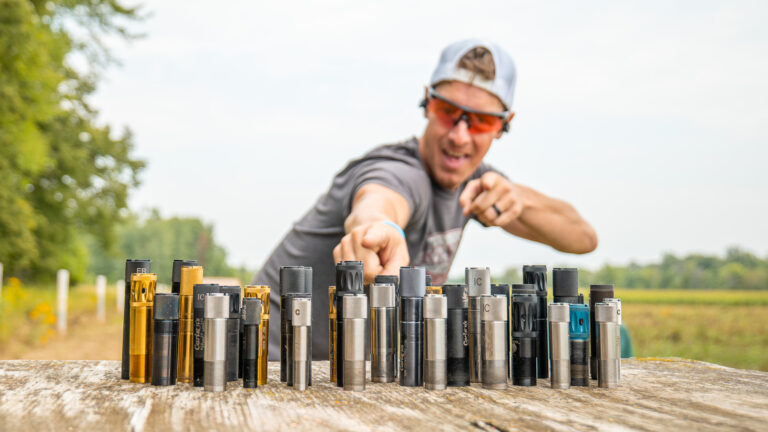


Sub-gauges have become a lot more common in the duck blind over the last several years, mostly because tungsten and bismuth let a 20 gauge hit like a much bigger gun. Now those same shells have gotten so expensive that they just aren’t realistic for a lot of waterfowl hunters, which begs the question: if you’re shooting steel, is the sub-gauge still a viable option? I had a Canada trip coming up and had planned almost a year ago to bring a 20 gauge, so I figured if it was a question I had, plenty of other hunters were asking it too. That’s what sent us to the range for a 12 gauge vs 20 gauge test with steel shot.
In this article
Quick take
The fix: Pick one load for the birds you see most, pattern it at real distances, and if you’re running a 20 gauge on steel #2s, let the birds come to you.
Works for: Field, water, and mixed-bag waterfowl hunts
Practice time: One range session, three to five patterns at each distance
Why there is no perfect waterfowl load
Before we shot a single pattern, we dug into Tom Roster’s 2016 Nontoxic Shot Lethality Table, and one thing became abundantly clear: no matter what gauge you shoot. There is no single load that covers everything from big Canada geese down to teal. Large geese are big targets, so Roster only calls for 50 to 55 pellets in a 30 inch circle, but they’re tough birds that need more downrange energy, which is why his table puts steel BB to BBB in front of them over decoys.
Small ducks flip that around. Teal, ruddies, and buffleheads call for 135 to 145 pellets in that same 30 inch circle, so a load built for geese leaves gaps a little duck can fly right through. Now to be fair, there is a difference between ideal and possible. You can still down a small duck with BBs at 30 yards, but your odds of wounding it or missing it completely go way up.
I think most of us have seen it happen. You shoot at a duck flying low over the water, the pellets hit all around it, and it keeps flying like nothing happened. That comes down to one of two things: either there weren’t enough pellets in the pattern and the bird flew through a gap, or the pellets didn’t carry enough energy to get the job done.
12 Gauge vs 20 Gauge: Same Pellet, Different Payload
Shot size, velocity, choke, the bird, and the distance all pull against each other, and it gets complicated fast. So for this test, we picked the load a lot of hunters reach for on mixed bags of ducks and geese, steel #2s, and ran it out of both a 12 gauge and a 20 gauge.
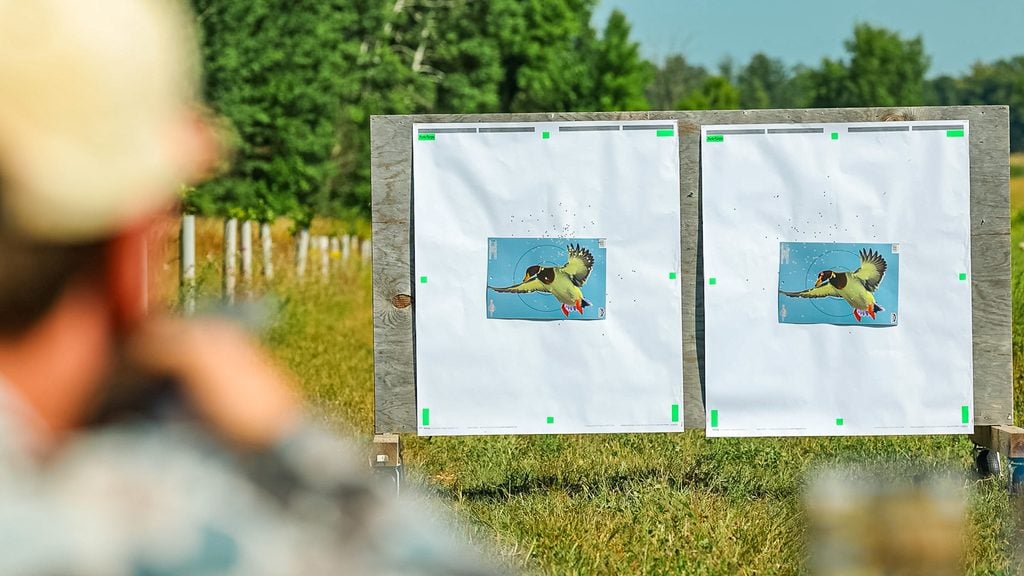
Here is the part a lot of people get wrong. A 12 gauge isn’t more powerful than a 20 gauge in the way most people think, because a #2 pellet at the same velocity carries the same energy downrange no matter which gun launched it. The real 12 gauge vs 20 gauge difference is payload. Our 20 gauge load threw 109 pellets and the 12 gauge threw 156, and that gap matters more the farther out the bird is.
In fact, the 20 gauge Federal Speed-Shok we shot was rated 100 fps faster than the 12 gauge load, and the 12 still patterned better at distance. Pellet count made the difference.
What the patterns and gel told us
At 20 yards, both guns were deadly. The 20 gauge put 99 percent of its pellets in a 30 inch circle, and I’d be confident taking a goose at that range with it.
At 30 yards, this is where the 12 gauge vs 20 gauge gap showed up. The 20 gauge with an improved modified choke dropped to about 64 percent in the circle, while the tighter-choked 12 held about 89 percent. Penetration in gel was still good with the #2s, so pattern density, not energy, is where the 20 starts to run out.
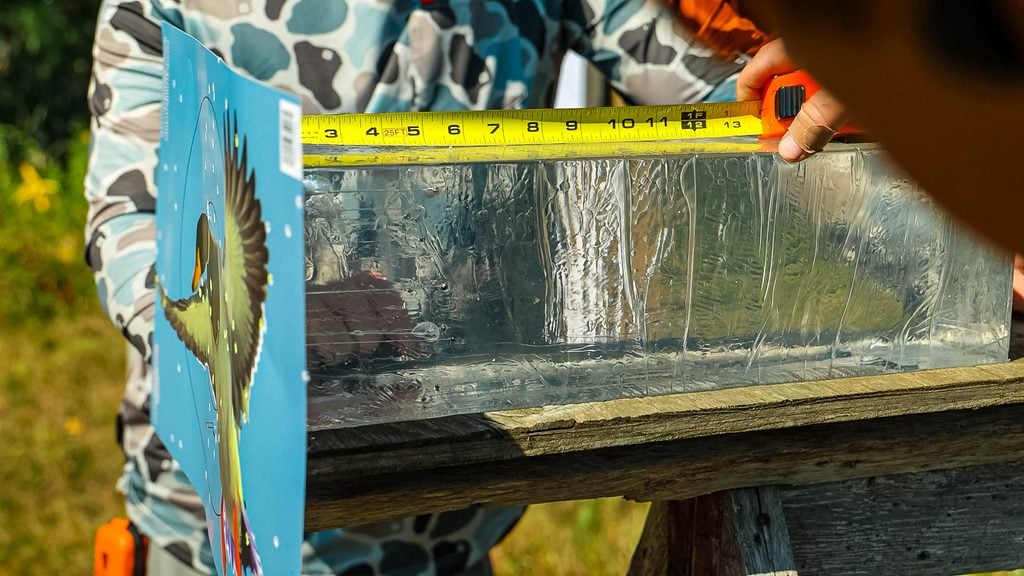
At 40 yards with a full choke, the #2s only lost about an inch of penetration compared to 30 yards, which surprised both of us. The pattern was the problem. It was too thin to trust on geese, and when we switched to #4s for more pellets, penetration dropped to roughly half of what the #2s did at 30. I’d call 40 yard ducks with #4s the far limit, and it isn’t a load I’d choose for that shot.
How to pick your load, step by step
- Know your birds: If you’re set up for geese and only shooting geese, it’s easy: grab a 12 gauge and BBs. If you’re only shooting small ducks, go with a smaller shot and more pellets. Most of us are shooting mixed bags, though, and that’s where you have to split the difference.
- Know your distance: Be honest about where birds actually finish over your spread, because that decides your shot size and choke more than anything else.
- Pick the pellet, then chase the pattern: Choose a shot size that carries enough energy at your distance, then find the shell and choke combination that gives you the best pattern density with it.
- Know where your sub-gauge stops: With a 20 gauge and steel #2s, if geese are coming in, I’m only looking at shots 30 yards and in.
Practice drill: pattern your own gun
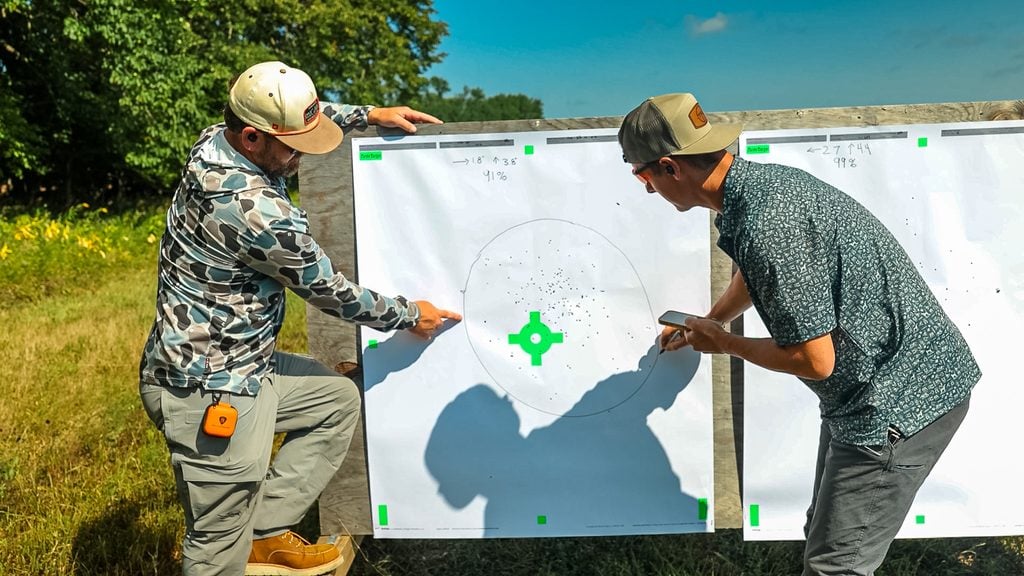
Hang a big sheet of paper and mark a 30 inch circle around your point of aim. Shoot three to five patterns each at 20, 30, and 40 yards with the exact load and choke you plan to hunt with, then count the pellets in the circle and note where the center of the pattern lands compared to where you aimed. Both of our Benellis printed several inches high, which is exactly the kind of thing you want to learn on paper instead of over the decoys.
Common mistakes
- Assuming the 12 gauge hits harder. Same pellet at the same speed means the same energy. What the 12 buys you is more pellets.
- Running one load for everything without knowing where it falls apart.
- Never patterning your gun. Without paper, you’d never know you’re shooting six inches high and to the left.
- Stretching a sub-gauge on steel past 30 yards on geese, where the pattern gets too thin to trust.
So, are sub-gauge duck guns dead?
My answer is no, but they are more limited now that tungsten is going by the wayside and bismuth is this expensive. A 20 gauge on steel still works if you let the birds get close and you know where your setup runs out of energy or pellet density. The bigger takeaway from this 12 gauge vs 20 gauge test applies to every gun in the blind: most of us could stand to spend a little more time on the range learning what our gun, ammo, and choke can actually do.
If you could only bring one gun and one load for a mixed bag of ducks and geese, what would it be?